tag:english.nd.edu,2005:/news-events/newstag:english.nd.edu,2005:/latestDepartment of English | News2026-10-08T14:39:00-04:00Notre Dame's English Department offers graduate and undergraduate degrees with a focus on literature’s cultural and interpretive contexts, creative writing, creative reading, film study, and literary history.tag:english.nd.edu,2005:News/1860512026-10-08T14:39:00-04:002026-10-08T14:43:32-04:00English professor Joyelle McSweeney wins 2026 Indiana Authors Award for Poetry
The University of Notre Dame’s Joyelle McSweeney, the William P. and Hazel B. White Professor of English, has been awarded the 2026 Indiana Authors Award for Poetry for her collection of poems, Death Styles.
Registered by the Eugene and Marilyn Glick Indiana Authors Awards, McSweeney received the prestigious award for poetry, offered biennially in recognition to a Hoosier author’s exemplary work in prose and poetry.
Winners of the Indiana Authors Awards receive $5000, with an additional opportunity to designate $500 awards to any Indiana library of their choosing. Winners are also invited to participate in a statewide speakers program.
McSweeney was recognized for the powerful message and emotion poured into her work, Death Styles, which navigates the difficult journey of moving on through grief. Her collection of poems was inspired by her own experiences after the death of an infant daughter. The New York Times Book Review noted her collection “is like a volcano, spewing details of pop culture and regular life amid waves of grief and perseverance."
Originally written as an attempt to bring herself out of the inability to write through the unbearable loss of a newborn child, Death Styles comes from a place of disciplined, daily writing. Inspired by various poets and musical compositions, McSweeney shares the emotional depths of grief and survival, stating her book “contracts like a uterine galaxy and starts again.”
As a follow up to her award-winning collection, Toxicon and Arachne, Death Styles is McSweeney’s tenth published book. In addition to the Indiana Authors Award for Poetry, she has received the 2026 Windham-CampBell Prize, 2022 Guggenheim Fellowship, and the Shelley Memorial Prize.
She is currently Department Chair of English at the University of Notre Dame, and has been recognized as the 2026 Notre Dame All-Faculty Team, and has twice been awarded the Rev. Edmund P. Joyce C.S.C. Award for Excellence in Undergraduate Teaching
]]>
Lydia Choitag:english.nd.edu,2005:News/1857422026-09-24T12:07:12-04:002026-09-24T12:07:12-04:00Pulitzer Prize-Winning Author Yiyun Li to speak at Notre DameYiyun Li, winner of the 2026 Pulitzer Prize for memoir and acclaimed author, will preview her new novel and speak about her work for the Asian American Distinguished Speaker Series lecture at 5:30 p.m. on October 6 (Tuesday) in the Eck Visitors Center at the University of Notre Dame. Author Azareen Van der Vliet Oolomi, the Dorothy G. Griffin College Professor of English, will moderate the livestreamed event, which is free and open to the public.
“Yiyun Li is a singular author, and we are honored to celebrate the launch of her newest work,” said Kyle Jaros, interim director of the Liu Institute for Asia and Asian Studies, which organizes the event. “The courage of Li’s prose is remarkable, as is her ability to bridge continents in writing.”
Born in China and raised amid the final years of the Mao Zedong era and the transformations of reform, Li moved to the United States in 1996, studying immunology at the University of Iowa before turning to writing fiction and becoming a US citizen in 2012. Li now serves as the Robert F. Goheen Professor in the Humanities and professor of creative writing at Princeton University.
In May, Li won the Pulitzer Prize in Memoir or Autobiography and the Andrew Carnegie Medal for Excellence in Nonfiction, awarded by the American Library Association, for her 2025 memoir “Things in Nature Merely Grow,” her account of losing her younger son to suicide six years after her older son died in the same manner. Suicide and mental health will be topics of Li’s conversation.
“Yiyun Li is one of our greatest writers. Her sentences are live wires: precise and ephemeral in equal measure,” said Van der Vliet Oloomi, a Liu Institute faculty fellow. “Li has that rare, unnameable gift of transforming the reader who encounters her work. She writes about grief, friendship, and what it means to be a writer with extraordinary intimacy and mastery.”
A member of the American Academy of Arts and Sciences and the American Academy of Arts and Letters, Li is the recipient of the 2021 Literature Award from the American Academy of Arts and Letters, as well as a Whiting Award, MacArthur Fellowship, Guggenheim Fellowship, the PEN/Malamud Award, the PEN/Faulkner Award, Princeton University’s Howard T. Behrman Award for Distinguished Achievement in the Humanities, and the Royal Society of Literature’s International Writers Award. Her work has been translated into more than 20 languages and has appeared in The New Yorker, “The Best American Short Stories,” and “The PEN/O. Henry Prize Stories,” among other publications.
Cover by Macmillian Publishers
Li’s visit will precede the official launch on October 13 of “Music Against the Night” by Macmillan Publishers, the first work in a trilogy that follows two eighteenth-century musicians as they pursue their ambitions from Dublin and French India across Europe, while grappling with political and artistic upheaval and sacrifice. The novel will be for sale at Li’s Notre Dame appearance.
The Liu Institute for Asia and Asian Studies organizes the Asian American Distinguished Speaker Series, which honors innovative, creative, and effective Asian American leaders and celebrates their contributions. This year’s lecture is sponsored with support from the Nanovic Institute for European Studies, Department of East Asian Languages and Cultures, Department of English, Department of American Studies, Gender Studies Program, Creative Writing Program, University Writing Center, Initiative on Race and Resilience, and the Institute for Social Concerns.
Part of Notre Dame’s Keough School of Global Affairs, the Liu Institute promotes awareness, understanding and knowledge of Asia through administering a supplementary major and minor in Asian studies, supporting student and faculty scholarship, organizing public events, and facilitating interaction and exchanges with partners in Asia. The institute was established by a gift from the RM Liu Foundation that supports the philanthropic activities of Robert and Mimi Liu and their children, Emily and Justin, both Notre Dame graduates.
Originally published by Jennifer Lechtanski at asia.nd.edu on September 24, 2026.
]]>
Jennifer Lechtanskitag:english.nd.edu,2005:News/1855402026-09-15T13:35:00-04:002026-09-15T13:35:08-04:00IRR Affiliate Faculty - ILS Faculty Fellow and MFA alum presents in LondonLeo Boix and Francisco Aragón in conversation
Institute for Latino Studies faculty member and MFA alum Francisco Aragón gave two presentations this summer in England. The first took place on July 15th at the Cervantes Institute, where Aragón read from his translation of, Handbook of Foams/Manual de espumas by Spanish poet Gerardo Diego. Aragón performed his own poems on July 18th at Torriano Meeting House, a cultural community center. He began his week in London as the special guest at a literary salon held in a private home on July 12th. Professor Aragón’s visit was supported by a Small Creative and Performing Arts grant from the Franco Family Institute and the ND Arts Initiative.
The event at Instituto Cervantes included the collaboration of British Latinx poets Leo Boix, Marina Sánchez and Soledad Santana. “The performance at Cervantes was the third stop of a multi-year tour where I’ll be inviting poets to join me in amplifying Gerardo Diego’s work. The poets in London that night also read a poem of their own—in conversation with Diego,” said Aragón, who directs Letras Latinas, the ILS’ literary initiative. Gerardo Diego (1896 – 1987), a member of Spain’s noted “generation of ’27,” wrote Manual de espumas in 1922 while living in a beach bungalow on the north coast of Spain. Aragón’s translation, published earlier this year by Shearsman Books, is the first English rendering of what many scholars consider one of Diego’s master avant-garde collections.
the Cervantes Institute, London
The reading at Torriano Meeting House two days later was part of Venn Diagrams, a reading series curated by British Latinx poet, Patrizia Longhitano. Billed as a “Latinx special edition,” the evening included the participation of poets Sim Pereira-Madder, Roberto Cenciarelli and, once again, Boix. “Leo was instrumental in helping me arrange my week—I couldn’t have done it without him. He’s a wonderful poet, editor, and translator. In fact, Letras Latinas aspires to bring Leo Boix to Notre Dame as a way of signaling ILS’ global reach,” added Aragón.
“Francisco’s visit felt like another important step in the transatlantic conversation we have been building for years now between US and British Latinx poets. An earlier collaboration brought writers from both sides of the Atlantic into dialogue, virtually. Having Francisco in London allowed that conversation to take on a new, tangible life,” said Boix, who was recently elected a Fellow of the Royal Society of Literature.
“What excites me most is how this continuing exchange reveals both what connects our literary communities and what makes them distinct. We write from different histories and different sides of the Atlantic, but our poetry travels through many of the same territories: migration and belonging, bilingualism and diaspora, Latin America and the places we now call home, Spanish and English—and everything untranslatable in between. His time with us strengthened an alliance that was already flourishing, while opening new possibilities for collaboration,” added Boix, the award-winning poet and author of two books in Spanish, published in his native Argentina, and two books in English, published in the UK, the most recent, Southernmost: Sonnets (2025), which was shortlisted for the Foreword Prize in 2025 for best poetry collection.
From left to right: Leo Boix, Francisco Aragón, and Nathalie Teitler
The literary salon that kicked off Aragón’s week in the British capital was hosted by Nathalie Teitler, who has run literature programs promoting diversity in the United Kingdom for more than twenty years. She also served as co-editor of the groundbreaking anthology, Un Nuevo Sol (2019), which showcases British Latinx writers, and which Aragón had endorsed with a blurb.
Notre Dame’s campus community will have an opportunity to experience a multi-voiced presentation of Gerardo Diego’s poetry on September 30th as part of “En Otras Palabras: panel & performance.” Aragón will be joined by poet-translators, Rosa Alcalá, Kristin Dykstra, and Rachel Galvin who, in addition to reading from Handbook of Foams, will each perform a piece of their own. Attendees will also hear Alcalá and Dykstra read from their own work that evening. Earlier in the day, Galvin will introduce and moderate an afternoon panel on poetry in translation. These two sessions are co-presented by ILS and Notre Dame’s Creative Writing Program, of which Aragón is an alum.
Originally published by Institute for Latino Studies at latinostudies.nd.edu on September 01, 2026.
]]>
Institute for Latino Studiestag:english.nd.edu,2005:News/1849902026-08-21T10:48:00-04:002026-08-21T10:48:17-04:00Should I Teach at a Liberal Arts College or Research University?
Shrinking departments and hordes of qualified candidates have transformed many academic job searches into a numbers game. The game is particularly unforgiving at highly ranked research universities, so for many of us, it’s worthwhile to consider another route to a tenure-track faculty job: the liberal arts college.
What Do These Terms Even Mean?
The difference between a “research university” and a “liberal arts college” is largely an American phenomenon, but it’s not always clear even for folks like myself who have spent their entire lives in the United States.
The structural distinction is whether an institution offers any (or very many) graduate programs. Because the purpose of grad school is usually to learn how to conduct research in a given field, research universities have a particular institutional commitment to supporting graduate education.
There are also, however, many differences in attitude or emphasis. The research university model is the default in academic circles, and liberal arts colleges often position their curricula or educational philosophies in contrast to this default. They might highlight excellence in undergraduate education, curricular flexibility, or unique aspects of their mission or values.
It is a misconception, though, that faculty at undergraduate-focused colleges do not or cannot carry out research agendas. Research still matters, especially at more selective colleges, and this is true across disciplines. The term “liberal arts” is not exclusive: many professors in STEM have fulfilling research and teaching careers at smaller colleges.
Pros and Cons of Teaching at a Liberal Arts College
Specific liberal arts colleges vary widely, of course, so make sure to research any institution where you are interested in applying. But most have several elements that make the teaching experience distinct from that of a research university appointment. Prospective faculty at liberal arts colleges might expect:
More hours devoted to teaching, mentorship, course development, and pedagogical growth. The overall balance of responsibilities is weighted more toward teaching activity, with most faculty teaching four to six courses per academic year.
A variety of teaching experiences. Because departments tend to be smaller, faculty at liberal arts colleges often teach a much wider range of courses. They also more frequently team-teach or design experiential learning programs outside their field or even beyond their department.
Less complex research infrastructure. There is much less pressure for faculty to secure large external grants, but this often corresponds to less institutional support for research overall. Not having graduate students to assist with projects often means a slower pace, and faculty who are not teaching graduate seminars may need to pursue other avenues to stay current in the field. Current faculty assure us, though, that it is possible to do so.
A broader definition of research. Tenure committees typically require fewer major publications, while also valuing public writing, scholarship in the field of education and pedagogy, and other forms of output that may carry less weight in the research university setting.
Slightly lower pay. Unfortunately, equivalent positions at liberal arts colleges usually offer smaller salaries than at large research universities. Geographical cost-of-living factors are still relevant, however.
Faculty governance. Professors at liberal arts colleges play especially active roles in institutional decision-making, with many opportunities (and responsibilities) to develop curricula, join task forces, and shape their work environment.
Action Steps
If you are interested in working at a liberal arts college, here are some steps you might take during graduate school to be competitive:
Take any available opportunity to teach, and keep all your materials. As you move through your coursework and dissertation research, collect ideas for classes you might want to teach in the future, as many job searches will require multiple sample syllabi.
Get involved with the center for teaching and learning on your campus. Here at Notre Dame, attend Kaneb Center workshops, request a peer observation, or even inquire about avenues to contribute to scholarship on pedagogy and teaching practices.
Develop administrative skills to prepare for faculty governance. For example, you might consider running for student government in your department or graduate school. You will also stand out if you work to demonstrate a human-centered understanding of issues that are transforming the landscape of higher education, like generative AI or intellectual freedom. Competence and vision for the future in these areas will make you a valuable colleague indeed.
Kyler Schubkegel is a graduate associate at Notre Dame Learning’s Kaneb Center for Teaching Excellence and is pursuing a Ph.D. in English at the University.
Originally published by Kyler Schubkegel at learning.nd.edu on August 06, 2026.
]]>
Kyler Schubkegeltag:english.nd.edu,2005:News/1849892026-08-21T10:47:00-04:002026-08-21T10:47:23-04:00‘Come out of the shadows’: English professor wins fellowship at Newberry Library for research on disability in Romantic theatreEnglish professor Essaka Joshua talks to an undergraduate English class. She’s been teaching and writing about disability and literature for over two decades. (Photo by Barbara Johnston/University of Notre Dame)
Essaka Joshua’s research has taken her from The New York Public Library to archives in Scotland, tracing the intersections of Romantic theatre and disability studies.
Her next stop is a little closer to home.
A professor of English at the University of Notre Dame, Joshua was recently named a 2026-27 long-term fellow at the Newberry Library. In January, she will begin six months of research at the Chicago cultural institution, as the Richard H. Brown/William Lloyd Barber and Mellon Foundation Fellow, and immerse herself in the library’s research community and wide range of historical materials.
“I’m excited to join this vibrant community of scholars working with the Newberry’s extensive European and American collections, and to have an extended period of research time to focus on this project,” she said.
Over the past two decades, Joshua has focused her scholarship on disability studies, especially in her 2020 bookPhysical Disability in British Romantic Literature. She wrote a chapter for that book about theatre and disability, but removed it to keep the focus on literature. She also wrote about disability in her most recent book, Disability and the Gothic: The Nineteenth Century (Cambridge University Press, 2026). She’s now further exploring the topic, and during her fellowship, she will draw from the Newberry’s rare books from the 18th and 19th centuries, as well as the library’s collection of circus ephemera — posters, handbills, postcards, and more — for her research.
Studying these artifacts from the circuses of 200 years ago will help answer her central research question: Where do we find disability in Romantic-era theatre?
“Circuses then were extravaganzas — they’ve got horses, they’ve got acrobats, they’ve got all sorts of interesting tricks they use to get people through the door,” Joshua said. “What I’m finding is that disabled actors are moving between circus spaces and theatrical spaces, and that happens particularly for actors with dwarfism.”
‘Calling the shots’
Essaka Joshua
Harvey Leach, a central figure in Joshua’s research, didn’t have dwarfism but was born with short, deformed legs that categorized him as a “dwarf actor.” His unique appearance, as well as his acrobatic and acting skills, led to a nearly 40-year theatre and circus career that spanned across Europe and the United States — an enormous and rare achievement for any actor in the Romantic era. Joshua discovered that Leach, who performed under the stage name Hervio Nano, was at the heart of the theatrical life of the period and very much in control of his career — he commissioned his own material, arranged his own tours, and found jobs for other disabled actors.
“Leach was probably one of the most famous American actors of his time, and no one has ever heard of him now,” Joshua said. “He’s a big discovery, and he needs to come out of the shadows.”
Joshua is also shining a spotlight on the life of another American performer, Joseph Stevens, who worked across theatres and museums, becoming a human exhibit for his dwarfism and an actor and docent for his talent and charm. He was a key star in advertisements for museums in New York City, Baltimore, and Philadelphia, and became famous after performing in an adaptation of Henry Fielding’s play Tom Thumb. His career spanned 25 years and laid the groundwork for P. T. Barnum’s more famous protégé, Charles Stratton.
Joshua also recently discovered the identity of a young man known as the ‘Drury Lane dwarf singer.’ Through her research, she found a resignation letter announcing his departure from the Theatre Royal, Drury Lane, and offering his services to the rival royal theatre at Covent Garden in London for a higher wage.
“These three actors are really indicative of the possibilities for some disabled people during that period,” Joshua said. “It was possible for disabled people in the Romantic era to not just be exploited exhibits in freak shows but to actually be meaningfully at the center of drama and calling the shots.”
Understanding disability
The stories of dwarf actors and their roles make up just one chapter in Joshua’s upcoming book, tentatively titled “Disability and Romantic Theatre 1780-1840.” The book shows many other ways disability shows up in theatre, from performance subject matter to audience member experiences.
“I’m trying to establish where disability becomes historically important, not just in a literary way or a theatrical way, but in a real-world way, too.”
In one chapter, Joshua highlights a particular 1801 play in which a deaf orphan finds his family and reclaims his noble title after learning sign language. It was performed at a time when sign language was not widespread, and often, deaf people and their families learned it was an option only after watching the play, Joshua said.
“Theatre is often thought of as this entertainment thing on the side,” she said. “But this play ended up being an advocacy tool, and it showed people why sign language matters.”
The book also examines stage madness — through the visual, costuming, and behavioral aspects of theatre. It additionally provides a history of accommodations in Romantic-era theatre, exploring questions like, “What happened if an actor went deaf in the middle of their career? How could a mobility-impaired audience member get to their seat? How did disabled actors break into the theatre world?”
“The heart of the book is the idea of keeping centered on the real world as well as the theatrical world,” Joshua said. “I’m trying to establish where disability becomes historically important, not just in a literary way or a theatrical way, but in a real-world way, too.”
Privilege and dignity
Essaka Joshua teaches about disability in Romantic and Victorian literature in an undergraduate English class. (Photo by Barbara Johnston/University of Notre Dame)
Joshua first became interested in disability studies 30 years ago, when the field's theoretical groundwork was being laid. Alongside the well-established critical, feminist, and Marxist approaches to literary analysis, Joshua taught using a disability-centered framework at the University of Birmingham. She found students were eager to use the new tool, which gave both pupil and teacher a unique worldview.
“I was confronting able-bodied privileges for the first time,” Joshua said. “What am I assuming about able-bodiedness and able-mindedness as I move through the world — and also move through literature?”
When readers abandon their assumptions before analyzing texts, they can uncover new possibilities for characters, stories, and meaning, Joshua said. A key element of disability studies is understanding that disability is not intrinsically bad, but instead a facet of humankind’s diversity. Therefore, it’s important to treat people with disabilities with dignity and study their stories with care, Joshua said.
“We should always reflect the variety of human experience in the study of culture more broadly,” she said. “It’s part of what’s interesting about the world.”
Originally published by Adah McMillan at al.nd.edu on August 19, 2026.
]]>
Adah McMillantag:english.nd.edu,2005:News/1851002026-05-29T10:50:00-04:002026-08-27T10:50:40-04:00Graduating seniors honored at Kroc Institute’s recognition ceremony
The celebration may have looked different this year, but the excitement was just the same.
Instead of an evening reception as in years past, this year the Kroc Institute, part of the Keough School of Global Affairs, hosted a celebratory breakfast on May 15 for graduating seniors earning a supplementary major or an interdisciplinary minor in peace studies. Families, friends and members of the Keough School community were invited to honor students and their accomplishments, and the 16 graduating seniors were recognized with a certificate of completion and a special gift.
Asher Kaufman shakes the handing of graduating senior James Thompson.
“You, our graduating class, give substance and shape to our hope for the future of peace in our world,” said Director of Undergraduate Studies Ernesto Verdeja, who offered opening remarks.
“During your time in the peace studies program and at Notre Dame, you have developed a rich intellectual understanding of the challenges we face, considered possible pathways toward solutions, and applied your learning by engaging in service, scholarship, public speaking and activism for peace and justice.
“Today, we celebrate your accomplishments with you,” said Verdeja.
Asher Kaufman, John M. Regan, Jr. Director of the Kroc Institute, also welcomed students and guests.
“The last few years have not been easy for us as a peace institute, with wars in the Middle East, violence and conflict spanning from Venezuela to South Sudan to Ukraine, and a systematic dismantling of peacebuilding agencies and democratic backsliding in the United States,” said Kaufman.
“All to say that peace studies graduates from the Kroc Institute are more needed now in our world than ever—and you here have the analytical and practical tools to make a difference.”
Following the distribution of certificates, the soon-to-be graduates were greeted as the newest members of the peace studies alumni network.
(L to R) Meghan Ellis, Maddie Colbert, Anne Hayner, and Coby McKeown.
“Thirty-nine years ago, just before he retired as Notre Dame’s president, Fr. Hesburgh launched an innovative new program at Notre Dame, then called a ‘concentration in peace studies,’ which in 1987 graduated its first four students,” said Anne Hayner, associate director for Alumni Relations.
“With the support of Joan Kroc the peace studies program has grown into a vibrant institute now offering programs at the undergraduate, master’s and Ph.D. levels, which together enroll dozens of students every year.
“The Kroc Institute is often listed as one of Fr. Hesburgh’s greatest legacies, but in fact it is you, the peace studies graduates, who are his living legacy. Congratulations to each of you, and welcome to the global network of peacebuilders,” said Hayner.
The recognition event also included the announcement of the Kroc Institute's annual undergraduate awards, which recognized graduates Madeleine (Maddie) Colbert, Jacob (Coby) McKeown, and Meghan Ellis.
Senior Award in Peace Studies
Maddie Colbert, who offered a blessing before breakfast began, was honored with this year’s Senior Award in Peace Studies. This honor is given annually to a senior who demonstrates both academic excellence and a future commitment to peace and justice in the world.
(L to R) Asher Kaufman, Maddie Colbert, and Ernesto Verdeja.
Colbert graduated with a major in global affairs, a major in theology, and a minor in peace studies. Her time at Notre Dame was marked by extensive engagement in service and experiential learning both on campus and in her home community. She was a long time active volunteer with Campus Ministry and BridgeND, interned at The Family Place in Dallas, and worked as an international visitors department intern with the World Affairs Council of Dallas-Fort Worth. She also completed summer study abroad courses in Rome and Uganda which focused, respectively, on Catholic approaches to peacebuilding, and religion, peace, and development in Africa.
Last summer, Colbert was selected to be one of Notre Dame's student representatives in a delegation of U.S. Catholic universities traveling to Hiroshima and Nagasaki, Japan, for the 80th anniversary of the atomic bombing. As part of that delegation, she spent a week engaged in dialogue around the future of nuclear disarmament with Japanese bishops, community leaders, and university students. She then spent the last year organizing and facilitating a series of student disarmament webinars offered by the Catholic Peacebuilding Network, the voluntary group of lay and clerical peacebuilding practitioners and academics administered by the Kroc Institute.
“What I have loved most about peace studies at the Kroc Institute is its ability to embrace both the deeply human and the academically-complex,” said Colbert. “My experience here has given me the tools to evaluate and address real, complex issues while prioritizing the dignity of the human person.”
After graduation, she will spend a year doing service work with Jesuit Volunteer Corps in Baltimore, Maryland, supporting faith and justice work at a local parish.
Senior Seminar Essay Award
The Senior Seminar Essay Award recognizes the research excellence of peace studies majors and minors.
Coby McKeown and Professor Gerard Powers.
All students in peace studies complete a senior capstone course, which offers the opportunity to reflect on their place in the field and produce a substantive research paper. The professors of the course nominate the strongest papers from their sections, and the nominated essays are forwarded to a faculty committee for a blind review.
This year's first place award was given to Coby McKeown, who graduated with a major in English (creative writing concentration) and supplementary major in peace studies. McKeown’s paper, “Proposed U.S. Policies to Change the UAE's Involvement in the Sudan War," was written as part of the senior seminar taught by Gerard Powers.
The second place award went to Meghan Ellis, who graduated with a major in biological sciences and a supplementary major in peace studies. Ellis’ paper, "The Arc of Access: Assessing the Success of Three U.S. Disability Activist Campaigns," was written as part of the senior seminar taught by Laurie Nathan.
Originally published by Kate Chester at kroc.nd.edu on May 28, 2026.
]]>
Kate Chestertag:english.nd.edu,2005:News/1826052026-05-14T00:00:00-04:002026-06-18T10:19:17-04:00‘Embracing uncertainty and opportunity for learning’: Grace Leeson ’26 brings medical and language expertise to where she’s needed mostSenior Grace Leeson majored in English with a supplementary major in Arts & Letters pre-health and a minor in compassionate care in medicine, preparing to become a doctor. (Photo by Jon L. Hendricks/University of Notre Dame)
Grace Leeson wasn’t accustomed to being behind the pack.
But here she was in Puebla, Mexico — for a whole semester her junior year — and out of everyone in her cohort, she was the only one who was not either a Spanish major or a native speaker.
Most of her classes were entirely in Spanish, she was living with a Spanish-speaking host family, and she’d be shadowing Spanish-speaking doctors. Though she’d taken enough Spanish classes to meet her program’s prerequisites, Leeson wasn’t fluent.
Grace Leeson performs in front of the Word of Life mural in an Acoustic Cafe pop-up concert. While at the University of Notre Dame, Leeson also shared her musical talent through the Music is Medicine Club, a volunteer group that plays music for nursing home and hospital patients. (Photo provided by Grace Leeson)
“I was super stressed out, like, ‘Am I going to be able to do this? Is this OK?’” she said.
In her moment of doubt, she called her parents for advice, and they reminded her why she’d gone to Puebla: not to be the best in Spanish, but to learn — to trust the process and immerse herself.
So that’s what Leeson did. She chatted with her host family. She picked up Spanish medical terms from labmates. She even joined a local tennis club. By the end of the fall semester, Leeson was presenting medical research she’d translated from Spanish herself.
“Embracing that uncertainty and opportunity for learning and growth was the best thing I could’ve done for myself,” she said.
Puebla was one of many adventures for Leeson. In her time at the University of Notre Dame, the 2026 graduate — majoring in English and Arts & Letters pre-health with a minor in compassionate care in medicine — has traveled to several Latin American countries, taken up Latin dance, joined a cooking club, and performed pop-up concerts.
All of this has led to her eventual goals of becoming a doctor while keeping her passions at the forefront.
“I’ve had the opportunity to bounce around and do a bunch of different things and be in different places,” she said. “It’s just part of my nature to be adventurous.”
Bringing creativity to medicine
Leeson’s original college plan was more of a straight shot, with less room for bouncing.
She applied to Notre Dame as a biology major, thinking that would be the best way to prepare for medical school. But after some soul-searching, she switched to English, with Arts & Letters pre-health covering the MCAT prep and medical school prerequisites.
“An undergraduate education is a great opportunity to pursue the things you won’t get to later,” she said. “I’ll have plenty of science in medical school, so I wanted to study something I really enjoy.”
As an English major, Leeson dove into topics that pique her interest, like Afro-Latin American literature or wartime Ukrainian poetry. While her motivation for picking the major was primarily passion, she was also hopeful that becoming a better communicator will make her a better doctor. After all, even the smartest doctor can only do so much if they can’t communicate with their patients, she said.
“There’s no doubt that I’ve always loved the science aspect of medicine. But I’ve also always loved music and reading and English and dancing and sports, too, and I don’t have any regrets about sacrificing anything in any direction.”
Her minor helps put that idea into practice.
The compassionate care in medicine program is based on research showing that being a compassionate physician, one who engages with their patients personally and processes their emotions, is more rewarding for patients and the physicians. Leeson learned the details of that research and explored topics including cultural competency, patient advocacy, and strategies to combat physician burnout.
In her medical counseling class, she took her first steps in a doctor’s shoes. Each session, a different student took a turn being the doctor, reviewing simulated medical sheets, and talking to faux patients. Leeson practiced articulating medical information so any patient could process it, translating her English skills into medical ones.
She’s taken patient communication to the next level for her capstone project. But instead of English or Spanish, she used a universal language: art.
During a summer fellowship, Leeson learned to illustrate various anatomical structures and medical procedures, and for her capstone, she researched how live medical illustration can help bridge the knowledge gap between doctors and patients.
“When a physician draws for you, specifically, it’s more personalized than just an infographic they can pull up online,” she said.
Drawing for a patient on a tablet or a sticky note can help them understand their condition and ask better questions about it, she said. Leeson researched the role medical illustration already plays in medicine and how it could be incorporated into the medical curriculum, hoping future physicians can hone the technique to better educate their patients.
And, as she nears medical school, Leeson is glad to have a wide variety of skills and experiences in her toolbox.
“There’s no doubt that I’ve always loved the science aspect of medicine,” she said. “But I’ve also always loved music and reading and English and dancing and sports, too, and I don’t have any regrets about sacrificing anything in any direction.”
Dedicated to service
A young Grace Leeson (left) in a lab coat with her brother, Drake Leeson ’24, who studied history at the University of Notre Dame. Grace Leeson grew up learning tidbits about the medical field from her parents, who are both doctors. (Photo provided by Grace Leeson)
Leeson has wanted to be a physician for as long as she can remember. But on a Campus Ministry trip to Honduras during her first year, in which she served poor rural communities, completely changed her perspective — about her life and her future career.
“Why am I complaining about getting up for an 8:20 a.m. when some people don’t have water for half the day?” she said. “I felt like I should be doing more for others.”
The experience motivated Leeson to find more opportunities for service, especially abroad. She joined Notre Dame’s chapter of MEDLIFE — Medicine, Education, and Development for Low-Income Families Everywhere — a nonprofit organization that sends pre-health students on service-learning trips to low-income communities in Latin America and East Africa. The trip gives students hands-on medical experience while improving communities’ long-term access to healthcare, education, and safe housing. Students distribute medicine, restock medical supplies, and run education campaigns alongside physicians, often serving people who’ve never met doctors before.
When Leeson joined MEDLIFE, the club had been hit hard by the pandemic and international travel restrictions. As a result, there were only three members, and Leeson worked to grow the club's membership and planned trips to Ecuador, Costa Rica, Peru, and Guatemala. The club has also started serving the South Bend community, making blankets for Beacon Memorial Hospital patients and running a winter clothes drive.
Grace Leeson records patient information at a MEDLIFE mobile medical clinic in Ecuador. (Photo provided by Grace Leeson)
Once Leeson completes her medical training, she doesn’t plan to take her skills abroad; she’s going home to South Texas.
“I’m going back to the place where I started, but I feel like there’s been so much growth between now and then,” she said. “I’ll be able to actually bring more back to my home state because of my experiences at Notre Dame.”
Leeson’s already had a few opportunities to give back to Texas during her summers at home by shadowing doctors and conducting research at hospitals. For one project, she researched the effects of food insecurity on Hispanic patients with diabetes, practicing her paper writing and Spanish skills.
Her desire to heal in Texas, home to millions of Spanish speakers, is a major reason Leeson chose to study and serve abroad. She’s hopeful that the language she worked so hard to learn will make her a more effective physician. And she’s especially enjoying one extra benefit of Spanish fluency — she can now talk to her Cuban grandmother in her native language.
While most future physicians take a gap year before medical school, Leeson is going full steam ahead — she’s already received a few acceptances from Texas medical schools. But no matter where she goes, Leeson knows her priorities.
“I can’t say for certain where I’ll end up after medical school,” she said, “but I want to go where people really need it.”
Originally published by Adah McMillan at al.nd.edu on May 14, 2026.
]]>
Adah McMillantag:english.nd.edu,2005:News/1816662026-05-12T15:09:00-04:002026-05-12T15:11:44-04:00In memoriam: Xavier Navarro Aquino, assistant professor of EnglishXavier Navarro Aquino
Xavier Navarro Aquino, assistant professor of English, unexpectedly passed away Wednesday (May 6). He was 36.
“Xavier's writing and artwork communicate with absolute clarity his humane and painterly care for the world in all its damage and beauty,” said Joyelle McSweeney, chair of the Department of English and former director of the Creative Writing Program. “His evident joy and commitment as a teacher inspired joy and commitment in his students, and his immediate legacy will be as an artist whose sense of beauty will be carried outwards to his readers, and to his students, and to their future readers. His loss is immeasurable.”
Navarro Aquino’s debut novel, Velorio (HarperCollins, 2022), takes place in the aftermath of Hurricane Maria’s devastation in Puerto Rico. The novel earned high praise from a range of media outlets, with the New York Times Book Review calling Aquino “an incredibly talented young writer,” and the Chicago Review of Books describing it as a “complex, politically engaged work and deeply human story.”
“Velorio is a beautiful, poetic novel — reminiscent of William Faulkner's classic The Sound and the Fury,” said Johannes Göransson, a professor of English and director of the Creative Writing Program. “His attention to language is the kind of writing we might associate with a poet.”
Navarro Aquino was awarded a Bread Loaf Writers’ Conference scholarship, a Tennessee Williams scholarship from the Sewanee Writers’ Conference, a MacDowell Fellowship, and an American Council of Learned Societies Emerging Voices Fellowship at Dartmouth College. He was named a Fall 2021 Writer to Watch by Publishers Weekly. His fiction also appeared in Tin House magazine, McSweeney’s Quarterly Concern, and Guernica.
Born and raised in Puerto Rico, Navarro Aquino earned his bachelor’s degree from Iowa State University, a master’s degree in English and Caribbean studies from the University of Puerto Rico, Río Piedras, and his Ph.D. in literature and creative writing from the University of Nebraska-Lincoln. He joined the Notre Dame faculty in 2021.
“Despite all of the early acclaim, Xavier was very humble and self-effacing. Our conversations were more often about soccer, or running, or tattoos than his writing,” said Mark Sanders, a professor of English, professor and chair of the Department of Africana Studies, and director of IRR at the time Navarro Aquino was hired. “Xavier was a dedicated teacher, an enormously talented writer, and a warm and caring human being. His fiction reflected his care for the world, as Velorio can be read as a cautionary tale about how not to treat one another under the most trying conditions. He was dedicated to representing Puerto Rico and to supporting universal human rights.”
A devoted and enthusiastic presence in the classroom, Navarro Aquino taught courses on fiction writing, the American short story, literary debuts, and the role of storytelling in addressing modern, pressing issues. He directed both MFA and undergraduate honors theses. In recent years, he had become exceptionally passionate about painting.
Jason Ruiz, a professor of American studies and director of the Institute for Latino Studies, fondly recalls a visit Navarro Aquino made this semester to his course, The Cutting Edge in Latino Studies Research. Amidst a lively conversation about his life and work, Navarro Aquino also shared his short story, “Two Young Kings,” which Ruiz described as “brilliant and devastating.”
“I already admired Xavier as a writer and teacher, but the class session really floored me, as he showed a wonderfully open, honest, and intelligent approach to his work and his vision for Latino literature,” Ruiz said. “He was the kind of professor who elevated our ongoing conversations around Latinidad and inspired the students and me to be ever more thoughtful in our approach to a complex subject matter that touches the very cores of our identities.
“He was not in any way precious about his work but embraced just about anything that we, the readers, could find in it. Xavier was an irreplaceable member of our community and his loss will be felt for a long time to come.”
Navarro Aquino is survived by his wife, Jayleen Santiago Diaz.
A memorial Mass will be held at 9:30 a.m. Monday, May 18, in the Basilica of the Sacred Heart, with University President Rev. Robert A. Dowd, C.S.C., presiding.
Condolences may be sent to the Department of English, 233 Decio Hall, Notre Dame, IN 46556.
Originally published by Josh Weinhold at al.nd.edu on May 12, 2026.
]]>
Josh Weinholdtag:english.nd.edu,2005:News/1807952026-04-14T14:43:00-04:002026-04-14T14:43:45-04:00English professor Joyelle McSweeney wins prestigious Windham-Campbell Prize for poetryJoyelle McSweeney, the William P. and Hazel B. White Professor of English
The University of Notre Dame’s Joyelle McSweeney, the William P. and Hazel B. White Professor of English, has won the Windham-Campbell Prize for her work in poetry.
McSweeney, who chairs the Department of English in the College of Arts & Letters, was one of eight writers to win the prestigious annual global literary award, administered by Yale University’s Beinecke Rare Book & Manuscript Library, which recognizes exemplary work across fiction, nonfiction, poetry, and drama.
Winners receive $175,000 to support their work and focus on their creative practice free from financial concerns. With annual prize money exceeding $1.4 million — and total prize money awarded over the past decade at over $20 million — it is one of the most significant prizes in the world.
McSweeney was recognized by the prize’s anonymous selection committee for her “complex, powerful, and contemplative ecopoetic writing, exploring nature, trauma, style, and resilience through the ‘necropastoral’, whilst subverting our understanding of contemporary language.”
“Joyelle McSweeney’s wildly imaginative, rageful poems turn decay into sustenance and go on defying death by thriving on rot,” they wrote.
McSweeney has written nine books, her most recent being the 2024 poetry collection Death Styles. Her 2022 double poetry collection, Toxicon and Arachne, was named a finalist for the Kingsley Tufts Award and won the Shelley Memorial Prize from the Poetry Society of America. McSweeney wrote the first part during the years leading up to the birth of her third daughter, Arachne, and wrote the second part in the spring following Arachne’s brief life and death.
She attributes her work to an “obsession” over the idea that what we think is over is indeed not over and that she writes her poetry to come alive in the moment of performance.
“Poetry, for me, is a quest to find out why we have to live this way, what the gods might have in store for us, how we can get back what we lost, and what we can give to each other,” she said.
“This prize recognizes the body of work I’ve created during my 20 years here at Notre Dame, in which I’ve been inspired and supported by so many colleagues in every discipline,” she said. “In this sense, this prize also recognizes Notre Dame’s unwavering support for research and creativity across science, humanities, and the arts. We need every route to Truth, and we need to do it together.”
Originally published by Mary Kinney at al.nd.edu on April 09, 2026.
]]>
Mary Kinneytag:english.nd.edu,2005:News/1807982026-03-31T17:00:00-04:002026-04-16T12:52:55-04:00Professor Abram presents on <i>Beowulf</i> as a Franco Humanities Fellow
The phrase of the day was “thought experiment.” What kind of objectification might be considered moral? How would a hypothetical vengeful nurse deny the dignity and humanity of a patient? What would it take to create a critically successful Hollywood treatment of an Old English epic?
The third workshop of the Franco Humanities Fellows for the 2025-2026 academic year took place on Thursday, March 19. This workshop culminates a year of interdisciplinary conversation and research among the fellows. The two previous workshops followed work from the broadest range of periods – Faliscan cooks and early Chinese empire, contemporary Chicago soundscapes, the politics and experience of learning disabilities in the present, and how we plan for the future. This final workshop let the fellows dive into representation and language in important and novel ways, and with similarly impressive range, in papers that focused on a single word to a seemingly infinite library of translation, and from Romantic Poetry to midcentury philosophy and science fiction.
The first fellow to present his work was Michael Rea. Rea is a professor of philosophy and this year’s Hesburgh Women of Impact Humanities Fellow with his project Love, Beauty, and Objectification. This book explores the interplay among the three concepts in its title, asking how beauty might ground both love and objectification and teasing out the implications of this dynamic. Kate Kirkpatrick, a philosopher at Oxford University and author of Becoming Beauvoir: A Life (Bloomsbury, 2019), situated Love, Beauty, and Objectification with regards to Simone de Beauvoir’s arguments in her 1946 study The Second Sex. In particular, she explored the consequences of Rea’s work for concepts like “Love of Life” and “Will to Be.” Cristian Mihut, a philosopher at Bethel University and author of Gracious Forgiveness: A Theological Retrieval (Oxford University Press, 2023), posed several hypothetical test cases for Rea’s thinking about empathy in relation to objectifying behaviors and attitudes.
Reflecting on the experience, Rea expressed gratitude for his involvement in the fellows program. “I’m very grateful to the Franco Institute for bringing Kate and Cristian to provide comments. The discussion with Kate and Cris and with my Franco Institute colleagues was enjoyable and quite helpful,” he said. “I’ve really valued the opportunity this year to engage with the work of my colleagues in other disciplines, and I think that this fellowship program provides a tremendous benefit to the College and to the University.”
L-R: guest reviewer Chris Jones and faculty fellow Chris Abram
The conversation continued with Christopher Abram and his project Inventing Beowulf: Innovation and Tradition in the Post-Medieval Poem. Abram is professor of English and fellow of the Medieval Institute. He holds the Decrane Humanities Fellowship among this year’s cohort. His book aims to produce the first comprehensive, critical history of how the most famous Old English poem became a cultural phenomenon in the modern period, and how its changing status across the nineteenth through twenty-first centuries has materially affected the form and substance of the text. Chris Jones, an Old English scholar from the University of Utah, responded. Jones is author of Fossil Poetry: Anglo-Saxon and Linguistic Nativism in Nineteenth-century Poetry (Oxford University Press, 2018). In his comments, Jones praised Abram’s warm and lucid prose and anticipated the book’s warm reception alongside such works as Hugh Magennis’s Translating Beowulf: Modern Versions in English Verse (Boydell & Brewer, 2011). The other fellows joined in the conversation and entertained questions that Beowulf adaptations often raise, including the long debate over the first word of the manuscript ("hwaet") and the perceived undertones of Grendel’s mother and the much-contested depiction of her in Robert Zemeckis’s 2007 film with Angelina Jolie.
"Discussing my work with the other Faculty Fellows and my external reader at the Franco Seminar was one of the most productive experiences of my career," Abram shared. "We so often end up working in isolation in the humanities, stuck in our disciplinary ruts; it was wonderful to share my ideas with scholars who come from very different disciplinary backgrounds. My colleagues read my work carefully, sympathetically, and critically, and they all shared insights from their own fields that will make my book better. It was a pleasure and a privilege to participate," he said.
"The Franco Faculty Fellowship program this year created an exciting forum for interdisciplinary conversation,” said Kate Marshall, Franco Institute Director. On the group wrapping up the first year of the program, Marshall added, “All of our fellows advanced their projects significantly. We are thrilled to welcome a new cohort this fall."
The Franco Institute staff invites everyone to stay tuned for future announcements about the incoming 2026-2027 group of fellows, and we are grateful for the outgoing cohort’s participation, interdisciplinary collaboration, and innovative research.
Originally published by Jacob Schepers at franco.nd.edu on March 31, 2026.
]]>
Jacob Scheperstag:english.nd.edu,2005:News/1804662026-03-31T08:09:39-04:002026-03-31T08:10:33-04:00Griffin Lunch with Professor Sandra Gustafson
On March 25, Professor Sandra Gustafson hosted the second event in this semester’s Griffin Faculty Lunch Series: The Spirit World of George Saunders. Over lunch, Professor Gustafson led students in a discussion of how Saunders’ work “focuses on the interface of life and death as a way to explore personal and social change.” While Saunders has authored highly decorated short story collections, Professor Gustafson and the group focused on his novels Lincoln in the Bardo and Vigil. Lincoln in the Bardo, published in 2017, won the year’s Booker Prize. In January of this year, Saunders published his second novel, Vigil. Attendees of the lunch received a copy of Saunders’ 2026 novel.
Throughout his fiction, Saunders represents a unique perspective on spirituality and its impact on life and death. During the lunch, students focused on key moments in each novel that relate to Saunders’ personal religious experience. While Saunders was raised Catholic, the author has practiced Tibetan Buddhism since the 1980s. With this knowledge, Prof. Gustafson encouraged students to note points of contact between the two religions within Saunders’ prose. By examining ancient religions in modern prose, students broadened their perspective on the nature and representation of spirituality in 21st-century literature.
Stay tuned for the next Griffin Student/Faculty Lunch!
]]>
Avery Gahlertag:english.nd.edu,2005:News/1803852026-03-27T16:51:00-04:002026-03-27T16:51:12-04:00Women Who Inspire: Dionne Irving Bremyer
This story is part of Notre Dame Global's series titled "Women Who Inspire."
If there’s one thing Dionne Irving Bremyer tries to impart on every student that she teaches, it’s that they will leave her class as better thinkers and better humans.
And it’s not because they’re debating philosophy or studying sociology. It’s because they’re reading and writing, and in doing so, they’re learning how to think critically and compassionately about the world around them. If reading reveals the near-invisible threads that tie us together across countries, cultures, and chasms of differences, writing is what helps us parse through those threads, form our own opinions about them, and integrate their meaning into our lives.
An associate professor of English at Notre Dame, and instructor of the Notre Dame Kylemore Creative Writing program, Dionne has been with the University for five years. She’s a Giller Prize-nominated author, a finalist for the PEN/Faulkner Award for Fiction, and the director of Notre Dame’s Initiative on Race and Resilience. She’s a wife, a mother, and a self-professed “Real Housewives Historian.” She’s a story-consumer and a storyteller.
Dionne with her book at a bookstore in San Francisco.
Stories are how Dionne engages with the world and connects to other people. A Canadian native with Jamaican heritage, she’s long been interested in how narratives travel and find new meaning in each place they land, resonating deeply with audiences seemingly unlike their source. When Dionne went on tour for her collection of short stories, The Islands, she said that one of the most exciting parts was meeting people who’d read her work. “Writing is really solitary,” she admits. The stories she wrote, while fiction, were so personal to her own experience that she worried they wouldn’t resonate with an audience that existed outside her own head. But in meeting and talking with readers, her fears were quickly diminished. “I found the stories spoke to all different kinds of people.”
And that’s the beauty of storytelling, of reading and writing. They’re activities that exist in your mind, but at the same time, draw you out of yourself. They force you to encounter a reality outside of your own, and Dionne would argue that we are better for it. “How great is it that you can read a story of somebody in the Victorian upper classes, or you can read a story that's set in modern-day Nairobi, and you can have this transformative experience of time and place and culture?”
That’s why she’s not bothered by the fact that some students may not write again outside of the courses she teaches. Because even if they don’t realize it, they’re getting something invaluable out of the class: the ability to problem solve. “I think having the ability to think through the problems of other human beings is a real skill. How do we talk to each other? How do we think about the fact that there's a person out there whose life is remarkably different than my own, and meet them where they are?” These are the kinds of questions prompted by creative writing, Dionne says.
Dionne with her students from the summer writing course she teaches at ND Kylemore.
The values of empathy and community have long been central to Dionne’s work. In fact, she started as a psychology major in school because she wanted to understand other people’s lived experiences, their problems and struggles, and how community is created around those feelings that make us human. She soon realized she could accomplish the same thing through writing.
She credits the professors she had in school for encouraging her. It was never a question of “Can I do this?” because she was surrounded by teachers who affirmed her talent, and pushed her to go further with it. She even pursued a Ph.D., something she said she never thought she’d do. Now, as a professor herself, she hopes to send the same message to her students. She encourages them to engage with the world, to find things that interest them about people and their stories, and to be a devoted reader as well as writer if they want to pursue writing. Most of all, she teaches the importance of looking outside yourself. “I think good writers are in some ways anathema to selfishness,” Dionne says.
Dionne with her undergrad creative writing professor after a reading at her alma mater.
In her own writing, Dionne is especially inspired by writers like Toni Morrison and Audre Lorde, women whose voices contributed to and shaped conversations around identity, injustice, and community. Women, Dionne would add, have a natural role in storytelling. A former professor at Saint Mary’s, Dionne advocates for the power of community found in womanhood and sisterhood. “One of the things that’s interesting to me about women is the way that even our bodies carry stories.” Long after she’s gone, Dionne marvels at how her bones will retain and reveal a core aspect of her identity: mother.
She points to how this idea of women as the “keepers of stories” is reflected across cultures and in many religions, including that of Notre Dame, Our Lady’s University. “Why do we revere the mother of the deity? Because the mother is the thing that he can't be in the world without, right? Women are a conduit to storytelling, and I think that there's something really, really powerful about that.” It’s safe to say that Dionne has wielded that power well—and she's teaching her students to do the same.
Originally published by Jessie Carson at global.nd.edu on March 26, 2026.
]]>
Jessie Carsontag:english.nd.edu,2005:News/1795432026-02-25T16:33:00-05:002026-02-25T16:33:16-05:00Office Hours: Kate Marshall on the books, the artifacts, and the people that inspire her writing and leadershipKate Marshall types at her desk, her office full of the short novels that inspire her work. (Photo by Jon L. Hendricks/University of Notre Dame)
Stepping into Kate Marshall’s office is a bit like stepping into a one-room museum, with antique typewriters, artifacts of early cinema, and book-making tools among the pieces on her shelves.
“The objects I keep around me represent what I’m really excited about in humanist work,” she said. “There’s often an element of materiality — I’m interested in how texts are made and what media go into making them.”
This feature is part of a College of Arts & Letters story series called “Office Hours,” which provides a glimpse into the personal and professional lives of Arts & Letters faculty through their workspaces around campus. This installment highlights Marshall, the Thomas J. and Robert T. Rolfs College Professor in the Department of English, whose research and teaching focus on the interactions of media, technology, and genre in contemporary literature.
In this interview, Marshall discusses important pieces in her office that inspire her and are relevant to her writing, her roles as associate dean for research and strategic initiatives and director of the Franco Family Institute for Liberal Arts and the Public Good, and her personal life.
Marshall’s answers have been edited for clarity and conciseness.
Q: What do you want people to feel when they enter your office?
A: I want them to feel welcome and excited about research in the college.
The objects I keep around me represent what I’m really excited about in humanist work. I also have books related to the Franco Institute’s research theme, which this year is attention. For example, I have a book by one of the speakers of our symposium, How to Do Nothing by Jenny Odell, over here. I also have some books in the office that are related to the future of the humanities, something that we talk and think about in the Institute.
I think that it is important to pair your intellectual projects with the administrative work you do. I’m writing a book about the novella and reading short fiction in the age of attention, so I have a lot of very short books on my bookshelf — the things that I’m trying to think about as I continue my own research.
Kate Marshall surveys the three typewriters she keeps on her office shelf: an Underwood, a portable Hermes, and a Valentine. (Photo by Jon L. Hendricks/University of Notre Dame)
Q: What are the stories behind your typewriters?
A: These three are all very special to me. This is not my entire typewriter collection, but these are three key examples. They all have stories — and I think they look good.
They’re from different eras. The black typewriter, the Underwood, is an early 20th-century typewriter, and they were made in the same factories that were manufacturing weapons for World War I. The way in which media technology and military technology have gone together, I think, is an interesting part of its story.
The seafoam-colored typewriter is called a portable Hermes, Hermes being the winged messenger. It’s heavy, but you could carry it around. I really like it for the literary connection. The portable Hermes is the typewriter fictionalized in Patricia Highsmith’s The Talented Mr. Ripley — the one he used to forge identities.
The red typewriter, which is called the Valentine, is made by the Italian company Olivetti, and it’s an icon of 20th-century design. The case and the red, molded plastic typewriter have a really important design history, too.
When I moved to South Bend in 2009, there was still an open typewriter repair shop on Mishawaka Avenue. It’s since closed, but it made me feel like this town was a good home for me.
Q: When you’re sitting here, stuck with one of your projects, where do you look to get your mind rolling again?
I always look to the bookshelf. There are more novellas on this shelf than I could possibly write about in a single book, and I love to rearrange and move through them.
There’s a stack of the books that have been published in the book series I edit with the organization Post45 in the past few years. The theme of this series is literature and culture after 1945 — not necessarily explicitly American, but in the wake of the American century as a larger political and economic formation.
My second book, Novels by Aliens, came out a few weeks after I started the position as director of the Institute, so when I finally got to hold that book in my hands, I had just started working here in this office. The thesis of the book is that in the 21st century, there’s a desire for ways of seeing the world that are nonhuman. This is motivated by environmental concerns and ideas about agency that go beyond what has traditionally been understood as human.
I look at different interdisciplinary ways that this desire manifests in contemporary fiction and at its literary history. This is largely a story about genre, and one that I’ve continued to explore as I write my new book about the novella.
I also have a pile of all the objects I’ve found mudlarking. Mudlarking is when you walk along a river, specifically the Thames River in London, and you look for objects that wash up from the water that had been deposited or lost for years, even hundreds of years. You learn how to understand the tides, and you have to learn how to identify the things you find. I’ve found some clay pipes from different eras. One of them is Victorian and has a cricket bat design on it. Another is from the 18th century, and one is even older, probably from the 16th or 17th century. Two other pieces I have here are a fragment of a medieval shoe buckle and a fossilized tooth of either an older form of livestock or even some kind of larger animal — some of these teeth have been identified as belonging to mammoths.
Snapshots of Kate Marshall's bookshelves and sources of her inspiration: a stack of books from the organization Post45 (top), copies of her book Novels by Aliens, and objects she's found while mudlarking. (Photos by Jon L. Hendricks/University of Notre Dame)
Q: Your office has so many items from the past — what’s your newest piece?
A figurine of the statue of Athena from Nashville, Tennessee, next to a little blue Adirondack chair on Kate Marshall's windowsill. (Photo by Jon L. Hendricks/University of Notre Dame)
The most recent addition to the office would probably be a very kitschy figurine of the statue of Athena from Nashville, Tennessee. There’s a huge replica of the Parthenon and the statue of Athena in Nashville, so I picked that up when I was giving a lecture at the humanities center of Vanderbilt University last year.
That’s next to a tiny Adirondack chair, which is probably a little bit older but is maybe my most valued possession in the office. I teach in the summers at a place called the Bread Loaf School of English. Most of the students in the program are high school teachers, and I teach literature there. I live in Robert Frost’s farmhouse, and I experiment with different ways of teaching literature that I bring back to my classroom here, too.
When you are awarded a chair at Bread Loaf — I was named the Frank and Eleanor Griffiths Chair in 2019 — you’re presented with a teeny-tiny Adirondack chair as a memento of that award. It lives here as a reminder of the institution and the other people across the country who also have this award.
Q: Do you have anything here from your students?
Kate Marshall points out a print she received from one of her students. (Photo by Jon L. Hendricks/University of Notre Dame)
A: There are a few objects that have been made by my students over the years. That yellow and blue print is something made on the letterpress. It’s an excerpt that the student typed up from The Professor’s House by Willa Cather, which I taught in a graduate seminar. I also have this tiny work of book art that a student made.
The framed newspaper clippings were a gift from my first doctoral student. I started working with this student as her dissertation chair the year I came here, and she wrote a terrific dissertation about radio and modernism. And then when she left to take her job in New York, she left that with me as a memento of our time together.
It’s not everything, but keeping these objects in my Institute office helps me remember why we’re doing the work that we’re doing — supporting research, thinking about students, thinking about how we talk about the value of this work and really support it, both on campus and off. It’s nice to have some of those documents of students and ideas as a reminder for the why — why we do this work in the College.
Q: What serves as a good reminder in your office?
This image from an episode of The Twilight Zone called “Time Enough at Last,” which is the current working title for my book on the novella.
A still from The Twilight Zone episode "Time Enough at Last" on the very top of Kate Marshall's bookshelf. (Photo by Jon L. Hendricks/University of Notre Dame)
That picture is of the actor Burgess Meredith. In the show, his character is someone who’s a bookworm and feels like he doesn’t have any time to read. His home life doesn’t allow him to read, and neither does his job at a bank — his wife and supervisor get mad at him when he’s reading instead of working or doing anything else. So he’s beset with all of these problems with reading.
Then there’s a huge nuclear explosion or some kind of apocalyptic catastrophe, and he has locked himself in the bank vault to have time to read so no one can find him. He survives, and he comes out into a wasteland. There’s no one else in the world.
And then he finds the library, and this is the moment from which the title of the episode comes. He’s stacked up all the books in what order he’s going to read them in, and he says, “Books, books! Time enough at last!” And that’s exactly when he breaks his glasses.
That was the image that popped into my head when I got offered my job in the English department at Notre Dame in 2009. I wondered what was going to happen next, and I had so much joy, but I also knew that it would be something I shouldn’t take for granted.
From left to right, members of the Franco Family Institute team: Matthew Zyniewicz, Josh Tychonievich, Therese Blacketor, Alicia Sachau, Kate Marshall, Kayla Jewell, Aidan Morrison, and Jake Schepers. (Photo by Jon L. Hendricks/University of Notre Dame)
Q: What’s changed since you moved to this office?
English professors are fairly solitary. You teach, you work with students in classrooms, and you work with students in your office, and then you occasionally come together as a department or work on a committee. The rest of the time you are writing and reading alone.
But when I started working in this institute, everything about my life was both enriched by and dependent on all of the amazing people who work here. I spend five days a week in this office, and it’s a very alive, very permeable space. We all fit in a pretty tight space where we work with undergraduates, we work with graduate students, we occasionally meet members of the community, we work with faculty. So we have a few different teams: people who work on faculty projects, a team that works on the student projects, a really amazing outreach and events team that’s helping us do a lot more of our public-facing work as well as shepherd our fellowship programs. It’s a very collaborative workplace.
It’s really extraordinary to be at a university that is investing in the humanities and the liberal arts. Humanities, arts, and social science research are central to Notre Dame’s mission not only for faculty, but also for graduates and undergraduates. That is absolutely galvanizing, but none of it is possible without an extraordinary group of people to make it happen — and the people in the Franco Institute are just really making it happen.
Originally published by Adah McMillan at al.nd.edu on February 25, 2026.
]]>
Adah McMillantag:english.nd.edu,2005:News/1795422026-02-23T16:29:00-05:002026-02-25T16:30:41-05:00‘A greater understanding of truth’: English professor studies medieval poetry to converse with the pastAnn Killian pages through a manuscript, titled A Mirror to Devout People, from the early 15th century in the Rare Book Room of the Hesburgh Library. The assistant professor of English researches and teaches about medieval literature and devotional culture. (Photo by Jon L. Hendricks/University of Notre Dame)
In medieval England, a woman named Margery Kempe decided to devote her life to pilgrimage.
After a sudden and intense religious conversion, Kempe began traveling around England to listen to sermons and meet with mystics, gathering an account of her life and what she learned into a record known as The Book of Margery Kempe — one of the earliest autobiographies written in English. She did this despite a lack of any formal education in reading, writing, or theology, depending on preaching, song, and those who read out loud to her.
Now, 600 years later, Kempe’s words — the patterns and rhymes she picked up from homilies and sermons — inform literary scholars of English aural culture in the Middle Ages. One such scholar is Ann Killian, OP, who follows Kempe's attempts to write her own life by borrowing language from the texts she heard and remembered.
An assistant professor in the Department of English, Killian writes and teaches about medieval literature and devotional culture. She’s particularly interested in the social life of poetry — not just what was written down, but how it affected people in the past. In her in-progress first monograph, “Reforming Lyric: Poetry and Theology in England, 1380-1530,” she places the genre of religious lyric as a key proponent of the English vernacular’s legitimacy in scriptural teaching.
“Poetry had a larger life than what we see written in the books that we have,” said Killian, who came to Notre Dame after two years at Ohio Dominican University. “How did most people encounter this poetry, and how did it feature in theological education?”
Seeing the past through poems
Ann Killian, OP
Often, medieval poetry was written anonymously for other people to share. With the era’s low literacy rates, poems were designed to be easy to remember and repeat by people who couldn’t encounter them through writing. A priest might write a poem as the lyrics for a religious procession, for his parishioners to say, or to use in sermons.
For Killian — a fellow of the Medieval Institute, where she also spent two years as a postdoc after earning her Ph.D. from Yale University — this literary culture provides an excitingly complex way to piece together an image of a time marked by the religious controversy leading up to the Reformation. But recently, she’s been studying a medieval poet who’s an exception to the standard of anonymity — John Audelay.
He created a book of poems he wrote and poems he collected and wanted to preserve, but unlike most medieval authors, he wrote himself into many of his poems, saying things like, “Pray for me, the Blind Audelay.”
The reason Audelay perhaps wanted readers to pray for him, Killian said, was intense guilt. The poet worked as a chaplain for a noble family, so when his lord — a person whose moral behavior Audelay considered himself responsible for — caused the death of a parishioner, Audelay’s poetry became a cry for absolution.
“We all have some little bit of understanding that comes from our own life experiences, our own insight, and we can only move toward a greater understanding of truth from being in dialogue with one another.”
“A lot of medieval literature betrays this ongoing anxiety about, ‘Have I done something I haven’t confessed or repented for?’” Killian said.
The unique traits found in Audelay’s work reflect the penance-based medieval justice system. Audelay is fearful his misdeeds endanger his salvation, but he tries to atone through his writing, she said, presenting his own redemption arc as an example others might follow.
Killian focused on Audelay’s poems about the joyful love of God, as opposed to his dread of death, in a chapter she wrote for an upcoming collection edited by Susanna Fein, a professor emerita in Kent State University’s English department.
Killian’s next project will examine how medieval writers describe and teach the practice of contemplation. In most medieval writing, contemplative prayer is illustrated as imagining Christ’s face when looking in a mirror — picturing oneself as a likeness of God to actually become more like God. But Killian is investigating a different analogy: gardening.
“Poets liken contemplation to breaking up hard soil, pulling up weeds, and planting seeds,” she said.
Killian argues that medieval writers, such as Mechtild of Helfta and Julian of Norwich, reconceived contemplation as inner work meant to benefit the community. Beyond self-transformation, contemplation bears fruit to nourish one’s neighbors.
This project will be part of her second book, “Mystical Ecology,” which will trace the way medieval contemplative writers engage with and think through the natural world in their prayer practice.
Imagining a different world
Ann Killian reads A Mirror to Devout People, an early 15th-century Middle English life of Christ and devotional guide. Written by a Carthusian monk for a nun at Syon Abbey, it served as a spiritual mirror for reflection, popularizing meditative reading on Jesus’ life among religious and laity. (Photo by Jon L. Hendricks/University of Notre Dame)
For Killian, finding new ways of seeing faith and self in old writing is a large part of what draws her to medieval poetry.
“Going back to the medieval world — it almost works in a similar way to fantasy or science fiction,” she said. “It’s imagining how the world could be otherwise.”
The world she wants to see is one built on community, and it’s one she’s already working to create as a vowed member of the Dominican Sisters of Peace, a congregation of Catholic women religious.
Part of the Dominican tradition is seeking truth, and Killian has exercised this charism in becoming a professor, which keeps her engaged in large academic conversations and lets her lead the seminar classes she’s always loved. Last semester, she explored morality, temptation, and human freedom with students in Demons, Tyrants, and Villains in Early English Drama. This semester, she’s bringing students on a literary journey from the Book of Job to the Black Lives Matter movement in the University Seminar course Life After Loss: Poets on Grief.
Killian wants her students to talk across time with past thinkers, artists, and poets — as well as with their classmates. The hope is they’ll understand who they are and what they want the world to be.
“Each of us has a piece of the truth,” she said. “We all have some little bit of understanding that comes from our own life experiences, our own insight, and we can only move toward a greater understanding of truth from being in dialogue with one another.”
Originally published by Adah McMillan at al.nd.edu on February 16, 2026.
]]>
Adah McMillantag:english.nd.edu,2005:News/1793982026-02-20T10:52:00-05:002026-02-20T10:52:26-05:00Student Internship Series - Emma Vales
This summer, senior Emma Vales took on New York City as a Professional Liability Insurance Underwriting Intern at Everest. This year, Emma is completing her double major in Marketing and English on the critical track, while serving as a Resident Assistant in Ryan Hall. Emma describes how her summer internship aligned perfectly with her background, combining written, analytical, and social skills.
Over the summer, Emma worked directly with architecture and engineering firms, “analyzing risk upon receiving insurance coverage applications from these firms, and completing write-ups about these companies with [her] opinion about whether [Everest should cover their claims] based on the associated risk.” Whether she was preparing an application review or presenting project updates, Emma’s proficiency in oral communication and presentation enabled clear, professional delivery in team meetings.
Reflecting on her internship, Emma emphasizes the flexibility and universally valuable skills developed within the English major. Drawing on her experience in a business-forward environment, Emma recommends to other English majors: “don’t be afraid to put yourself out there, even if you think a role wouldn’t align with your English major … It is a unique major that can lead to so many different careers because of its foundation of strong reading and writing skills.”
From the start of her college experience, Emma has valued the interdisciplinary appeal of the English major; the skills developed are crucial for careers across the arts, business, and science. Emma explains that, although English was not explicitly mentioned in her job description at Everest, “the skills I have gained from my English courses were invaluable in allowing me to stand out in the office.” For Emma, choosing English was a “no-brainer” because of how well it prepares students for any type of career.
]]>
Avery Gahlertag:english.nd.edu,2005:News/1793542026-02-18T13:19:00-05:002026-02-18T13:20:12-05:00Griffin Lunch with Professor Tim Machan - Vikings in America
Braving the cold, Notre Dame English majors gathered for the first Griffin Faculty & Student lunch of the semester. Hosted by Professor Tim Machan, the group explored historical evidence, imagination, and myth surrounding the presence of Vikings in America.
While there is historical evidence that Vikings briefly settled in Newfoundland, the documentable record of their presence in North America is sparse. Because of this, imagination and fantasy have filled in the historical gaps. Prof. Machan’s discussion focused heavily on “myths and projection, ideas that manufacture their own reality and are no less consequential for doing so.”
The conversation broadened from myth to long-term historical significance. Prof. Machan explained how the Vikings have channeled “nationality, ethnicity, gender, virtue, and valor,” influencing the “amusing and sometimes dangerous fantasies” projected onto their presence. Through the ever-changing American landscape of the past two centuries, the Vikings have remained present in the American imagination, from literature to film, and even to video games.
]]>
Avery Gahlertag:english.nd.edu,2005:News/1790372026-02-06T18:00:00-05:002026-02-09T09:25:31-05:00In memoriam: Ernest Morrell, the Coyle Professor of Literacy Education and professor of English and Africana studiesErnest Morrell
Ernest Morrell, the Coyle Professor of Literacy Education at the University of Notre Dame, died Wednesday (Feb. 4) after a long battle with cancer, surrounded by his wife and three sons. He was 54.
Morrell was a renowned literacy studies scholar who advocated for a radical reimagination of the relationship between students and texts. His work positioned literacy as a means of social justice, empowering young people to access information, exercise informed citizenship, and participate fully in civic and cultural life. His scholarly interests also included critical pedagogy, postcolonial studies, and global youth popular culture.
“On behalf of the entire Notre Dame community, we mourn the passing of Ernest Morrell, a beloved faculty colleague, dedicated administrator, and cherished friend to many,” said University President Rev. Robert A. Dowd, C.S.C. “As a renowned scholar who made significant contributions to his discipline, a superb teacher who inspired and challenged his students, and a visionary administrator, he enriched the Notre Dame community and all who knew him.
“Ernest’s life reflected a deep integration of the life of the mind and matters of the heart. Our prayers are with his family, especially his wife, Jodene, and their three sons, Skip, Antonio, and Tripp, and all who grieve his passing. We are grateful to God for Ernest’s life and presence among us, and his example will continue to inspire us.”
Father Dowd also announced that Morrell will posthumously receive the 2026 President’s Award — which recognizes pioneering and visionary achievements in research, public impact, or creative endeavors that advance the University’s goals — in honor of his intellectually ambitious, socially consequential work centered on a humanistic vision of education.
Morrell signing the American Academy of Arts and Sciences’ Book of Members at his induction ceremony in 2024.
Acclaim for Morrell’s work was widespread in academic circles. He was elected to the American Academy of Arts and Sciences, one of the nation’s oldest learned societies, in 2024, and he was also an elected member of the National Academy of Education and an elected fellow of the American Educational Research Association.
For the past decade, he has been included in the Edu-Scholar Public Influence Rankings, an annual listing published by Education Week that highlights academics with the greatest impact on educational practice and policy. Last year, he received the James R. Squire Award, a prestigious honor from the National Council of Teachers of English given only 31 times since 1967, for his long-lasting impact on English language arts education.
“Ernest lived his vocation with extraordinary generosity and purpose,” said Matthew Kloser, the Hackett Family Director of IEI. “His scholarship, leadership, and friendship shaped our institute in profound ways. He believed deeply in the power of education to transform lives, and he modeled that belief through his teaching, mentorship, and unwavering commitment to the common good.”
Morrell came to Notre Dame in 2017 after faculty appointments at Columbia University’s Teachers College; the University of California, Los Angeles; and Michigan State University. Before pursuing his Ph.D. at the University of California, Berkeley, Morrell worked as a high school English teacher in Oakland, California, an experience that grounded his scholarship in classroom practice and shaped his lifelong commitment to supporting educators and students, particularly those historically underserved by educational systems.
Revered as a teacher and an advisor, Morrell approached mentorship as a collaborative partnership, frequently publishing with his doctoral students to help launch their careers before they even defended their dissertations.
“Ernest cultivated a true ‘family tree’ of scholars whose work began with his guidance,” said Maria McKenna, a professor of the practice in Africana studies and education, schooling, and society. “His former doctoral students are a testament to his efficacy as a mentor, as he allowed them to quickly become his peers, continuing the work of critical education studies and pedagogy at institutions across the country. They learned his lessons well about the importance of building and strengthening communities that support equity and justice.”
He is the author of more than 100 articles, research briefs, and book chapters, and he wrote or edited 17 scholarly books, including Educating Harlem: A Century of Schooling and Resistance in a Black Community (Columbia, 2019), Stories from Inequity to Justice in Literacy Education: Confronting Digital Divides (Routledge, 2021), New Directions in Teaching English: Reimagining Teaching, Teacher Education and Research (Rowman & Littlefield, 2015) and Critical Media Pedagogy: Teaching for Achievement in City Schools (Teachers College Press, 2013), which was awarded Outstanding Academic Title by the American Library Association’s Choice magazine. His work has garnered more than 11,000 scholarly citations.
“Frederick Douglass said that ‘education means emancipation, it means life and liberty … It means the uplifting of the soul to the glorious light of truth.’ I can think of no one whose life better reflected those words,” said Nicole Stelle Garnett, the John P. Murphy Foundation Professor of Law. “Ernest was a truly exceptional scholar and a tireless advocate for policies that would benefit kids most in need of the light of learning. But, more importantly, he was a beautiful soul. His deep faith and love for his family, his friends and colleagues, and Our Lady’s University touched so many.”
Morrell is survived by his wife, Jodene Morrell, a teaching professor and associate director of the Center for Literacy Education; and their three sons, Skip, Antonio, and Tripp.
A wake will be held from 4 to 8 p.m. Friday, Feb. 20, at Kaniewski Funeral Home, 3545 N. Bendix Drive, South Bend. A funeral Mass will be celebrated at 2:30 p.m. Saturday, Feb. 21, at the Basilica of the Sacred Heart on Notre Dame's campus, with Father Dowd presiding.
Condolences may be sent to the College of Arts & Letters Dean's Office, 100 O'Shaughnessy Hall, Notre Dame, IN 46556. In lieu of flowers, donations may be made to literacy nonprofit LitWorld.
“Revolutionary Love,” a colloquium celebrating Morrell’s scholarship, will be held Tuesday, April 7, at the UCLA James West Alumni Center in Los Angeles. The event’s title references a quote from Morrell’s latest book, Critical English Education: Enduring Voices, New Perspectives, published last year with Nicole Mirra, Antero Garcia, Cati de los Rios, and Jamila Lyiscott.
“We want to be engaged in revolutionary love and practice with beautiful and brilliant minds,” Morrell and his co-authors wrote, “that are in front of us to do something that is eternal.”
Originally published by Josh Weinhold at al.nd.edu on February 06, 2026.
]]>
Josh Weinholdtag:english.nd.edu,2005:News/1784592026-01-16T08:26:00-05:002026-01-16T14:26:58-05:00Student Internship Series - Max Amend
Senior English major Max Amend brought his passion for literature back to the classroom this summer as an English teacher at his alma mater, Bellarmine College Preparatory in San Jose, California. At Bellarmine, Max taught 8th Grade English and Fundamentals of Grammar. For both courses, he developed the curriculum and syllabus, taught daily, offered individual support to students during class and in office hours, and gave detailed feedback on students’ writing and assignments. Building off his preliminary research in AI and motivation, Max encouraged his class “to critically think about AI and the role of literary scholarship in education” while reading Daniel Herman’s “The End of High-School English.”
In the classroom, Max taught works from authors such as Edgar Allan Poe, Gabriel García Márquez, Shirley Jackson, and James Baldwin. As a part of his Senior Thesis for the English Department’s Honors Concentration, Max has continued researching the life and literature of Baldwin. Max, masterfully incorporating his academic interests into his lesson plans, independent research, and on-campus coursework, recommends that fellow English majors “pursue [their] passion in the moment and see where it takes [them], how it makes [one] feel, and be open that through experience, interests may change. Don’t get stuck, in anything really, and use the Notre Dame network and support services as a launching-off pad to pursue the limitless possibilities open to those who think critically, work hard, and fervently pursue questions critical to our time.”
Alongside his English major, Max pursues minors in History and Education, Schooling, and Society (ESS). As part of his capstone in ESS, Max conducted research on AI and what motivates college students to use AI for academic related tasks. Max also works in Dr. Susan Blum's School Story Lab researching reading, how college students approach academic and non-academic reading, their methods of reading, and their mindsets surrounding it.
]]>
Avery Gahlertag:english.nd.edu,2005:News/1779982025-12-16T12:44:00-05:002025-12-16T12:44:59-05:00Chanté Mouton Kinyon Assists Notre Dame Dublin in Launch of “Daniel O’Connell: The Emancipator” Documentary
The University of Notre Dame Dublin welcomed over 280 guests for the Gala Premiere of Daniel O’Connell: The Emancipator, a landmark documentary on the life and legacy of one of Ireland’s most important historical and political figures.
The documentary marks the 250th anniversary of Daniel O’Connell’s birth and kicks off a series of screenings and academic events over the next three years, culminating in 2029 with the bicentenary of Catholic Emancipation in Ireland, one of O’Connell’s greatest achievements in his lifetime.
Directed by Ruán Magan and narrated by Domhnall Gleeson, Daniel O’Connell: The Emancipator is a Create One production in association with the University of Notre Dame, University College Cork, and RTÉ.
The documentary is supported by Ireland's Department of Culture, Communications and Sport and the Department of Foreign Affairs and Trade. It will be included in school curricula across the island of Ireland, as laid out in Ireland’s “2025 Programme for Government,” to highlight “how Irish identity was, and remains a European identity, while showcasing O’Connell’s contribution to intellectual and political thought on a global scale.”
“I would like to congratulate everyone involved in this excellent project,” said Taoiseach Micheál Martin TD, Prime Minister of Ireland, at the Cork International Film Festival. “It is a tough challenge to bring to life someone who was born 250 years ago, but you managed to do this with great success and to invite a wider national discussion about The Liberator.” (Read An Taoiseach's full speech here.)
“In a time of extreme social inequality, famine, and disease, Daniel O’Connell almost singlehandedly raised a nation from its knees and forced Britain, the most powerful empire in the world, to grant the Irish people their democratic rights.” - Domhnall Gleeson, narrator
The 50-minute documentary follows the journey of O’Connell, from a humble cottage in Kerry to one of the world’s most influential political leaders of the nineteenth century.
With insights from leading scholars from the University of Notre Dame, University College Cork, Trinity College Dublin, and University of Cambridge, the film illuminates O’Connell’s use of mass mobilization, oration, and a bold imagination to advance Catholic Emancipation in Ireland, the abolitionist movement in the United States, and other nonviolent, democratic movements worldwide.
Prof. Gary Murphy (Dublin City University), Prof. Chanté Mouton Kinyon (University of Notre Dame), and Ruán Magan (director)
Following the premiere screening, Gary Murphy, professor of law and politics at Dublin City University, hosted a panel discussion with director Ruán Magan and documentary contributor Chanté Mouton Kinyon, assistant professor of English at the University of Notre Dame.
Magan discussed the original seed of the documentary after an approach by Notre Dame Dublin, the stewards of Daniel O’Connell’s former home on Merrion Square, who sought to mark the 250th anniversary of his birth and reintroduce O’Connell to a new generation.
“What makes O'Connell less of a nationalist than The O'Rahilly or Pearse?” Magan mused. “They all contributed, together, to create this country that we have. The more I get to know O'Connell, the more I feel that none of what happened subsequently—the Irish Revival and then the Nationalist Movement that brought us independence—could have happened without O'Connell laying the foundations during those first five decades of the 1800s.”
Mouton Kinyon, an expert in transatlanticism, expanded the discussion to O’Connell’s international impact, particularly on Black American thinkers and abolitionists in the United States. His meeting with Frederick Douglass remains a seismic moment in the intertwined Black and Irish histories.
Countering the immediate gratification of the often leaderless, violent revolutions that swept Europe in O’Connell’s lifetime, Mouton Kinyon says that O’Connell offered people “a different way, this pacifist way…without revolutionary violence, but a revolution of thought,” and that’s what still resonates with us today.
The evening concluded with a special live performance of the film’s score by composer Colm Mac Con Iomaire (violin, bouzouki), accompanied by Declan Cosgrove (piano) and Muireann Ní Shé (vocals).
The medley included the air “Johnny Seoighe,” written by one of Mac Con Iomaire’s ancestors, and the sean-nos song “Dónall Binn Ó Conaill Caoin,” originally a poem written in celebration of O’Connell around the time of Emancipation, bringing the audience right back into that historic moment.
Watch the post-screening panel discussion and music here.
Daniel O’Connell: The Emancipator will premiere on RTÉ One on December 29, 2025, at 6:30 pm GMT. Screenings, events, and symposia will follow as part of the University of Notre Dame’s Global O’Connell series in the lead up to the bicentenary of Ireland’s Catholic Emancipation in 2029.
Contact: Maggie Arriola Fagan, associate director for partnerships and engagement, Notre Dame Dublin, marriola@nd.edu
Originally published by Maggie Arriola at dublin.nd.edu on December 09, 2025.
]]>
English Departmenttag:english.nd.edu,2005:News/1767182025-11-20T14:32:00-05:002025-11-20T14:34:22-05:00Irish Writers Initiative connects Notre Dame with Ireland’s new golden age of fiction
Ireland has long been celebrated around the world for its literary tradition, its unique relationship with language, and its writers’ talent for remaking genres.
Even in the context of that heritage, the past few years have been special. The island of Ireland is experiencing a new golden age of fiction, with writers from both the north and the south earning critical praise and prestigious awards in recent years.
Michael Magee
A new initiative at the University of Notre Dame is connecting the energy of the Irish literature scene with faculty and students on campus.
Michael Magee, whose debut novel Close to Home (2023) has won several prestigious awards, is the initiative’s first writer-in-residence. He arrived at Notre Dame this fall and will be on campus for the full 2025-26 academic year.
Radvan Markus, a scholar of Irish-language literature and a faculty member at Charles University in Prague, is the initiative’s first critic-in-residence. He will be at Notre Dame for the spring 2026 semester.
Radvan Markus
The new initiative is spearheaded by Keough-Naughton Institute faculty fellows Clíona Ní Riordáin, the Thomas J. and Kathleen M. O’Donnell Chair in Irish Language and Literature in the Department of English, and Barry McCrea, the Donald R. Keough Family Professor of Irish Studies and Professor of English.
“Irish literature is leading the way at the moment,” Ní Riordáin said. “You have people thinking critically about the role Ireland plays in the world and how Ireland, as a post-colonial country, acts as a connector between the globalized South and Europe. It occupies an in-between space, and that’s what gives its literature such force and such appeal.”
McCrea added, “Irish literature plays a major role in the ecosystem of world literature, and Notre Dame is an influential institution within Irish literature; so the Keough-Naughton Institute’s focus on Irish writers is a key part of its global reach. Having an Irish writer and Irish critic on campus every year will further consolidate South Bend as a major literary hub.”
Magee’s first novel, Close to Home, is set in west Belfast, where he grew up, and deals with questions of class and conflict through the experiences of a young man who returns to his old neighborhood after graduating from college. The book is remarkable for its distinctive voice and humor and has received numerous awards, including the Rooney Prize for Irish Literature, the John McGahern Prize, and the Nero Book Award for Debut Fiction. It was the Waterstones Irish Book of the Year and has been translated into eight languages.
Magee is now working on his second novel.
“This residency is an opportunity I couldn’t possibly refuse,” Magee said. “Being able to work on a beautiful campus like Notre Dame is ideal. And I get to meet other writers, and meet students and see what they’re writing. I’ve got a novel curiosity about other people and their work, so it energizes me in all sorts of ways.”
“Irish literature plays a major role in the ecosystem of world literature ... ”
Markus teaches courses on modern Irish, old Irish, and Irish studies at Charles University in Prague. He has authored and co-edited several books, including the monograph Carnabhal na Marbh: Cré na Cille agus Litríocht an Domhain (Carnival of the Dead: Cré na Cille and World Literature), which was published in 2023 and received the American Conference for Irish Studies Prize for Books in the Irish Language, and the Czech translation of Ó Cadhain’s Cré na Cille (2017), which received the prestigious Magnesia Litera award.
During his residency, Markus will mainly work on a research project concerning representations of nature in Irish-language literature.
“I feel greatly honored by the offer of the fellowship, and excited about the opportunity to focus on my research, making use of the copious Irish studies resources available in Notre Dame’s Hesburgh Libraries,” Markus said. “I especially look forward to meeting old friends and making new ones, and exchanging ideas with staff and students alike.”
Both Magee and Markus will participate in public events as part of their residencies.


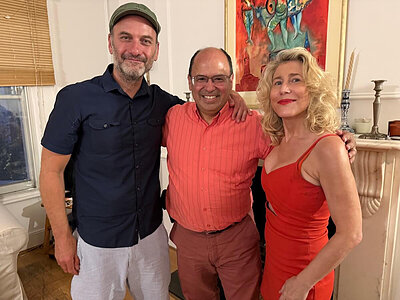


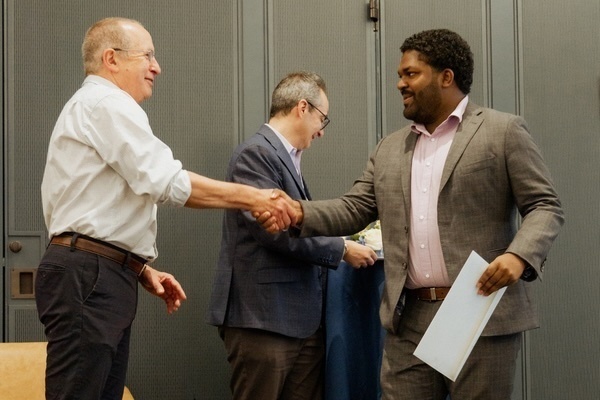


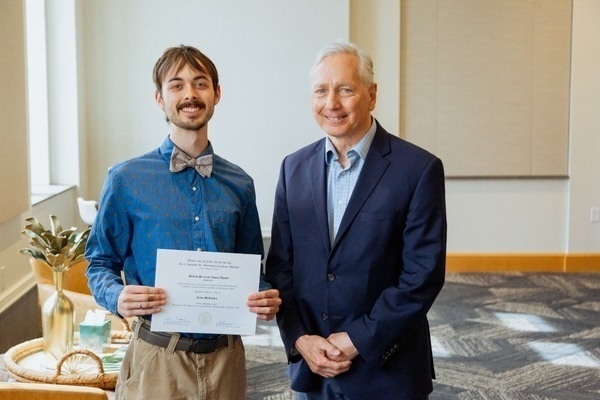

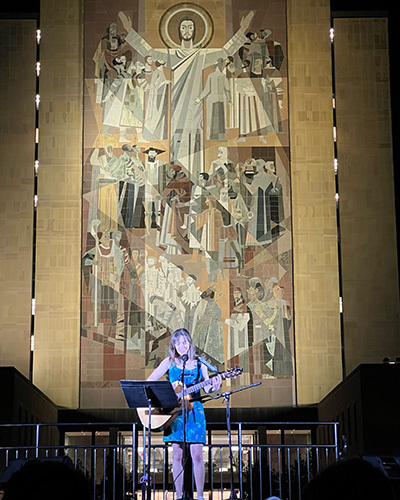
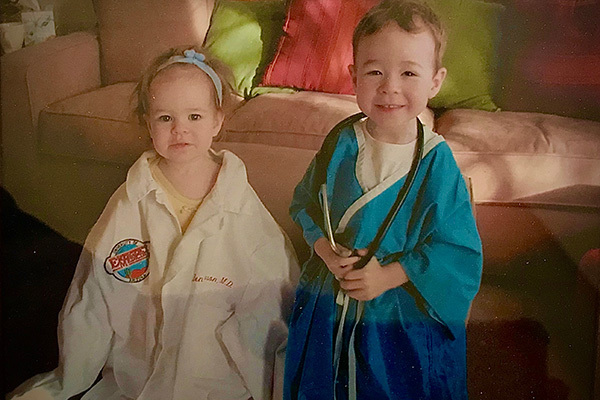



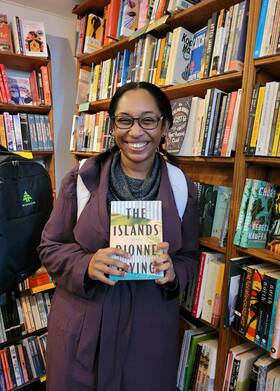
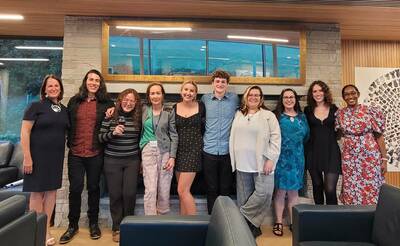
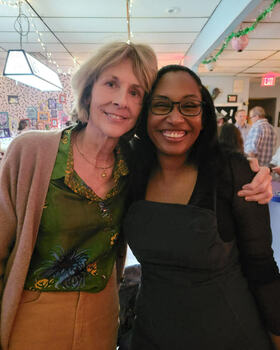


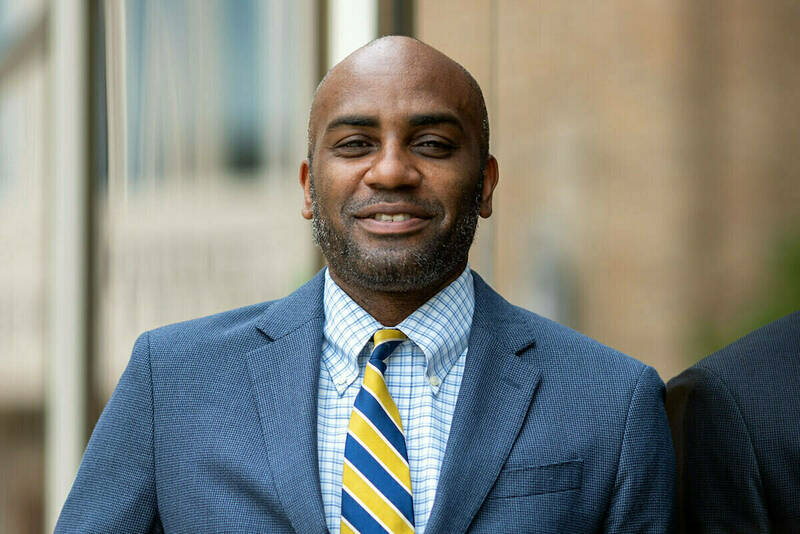
 Morrell signing the American Academy of Arts and Sciences’ Book of Members at his induction ceremony in 2024.